
For most active adults, the answer is significantly more than the official guideline suggests. The RDA of 0.8 grams of protein per kilogram of body weight per day is the minimum to prevent deficiency, not a target for health or performance. Research consistently supports 1.6 to 2.2 grams per kilogram daily for active people, with requirements shifting across life stages, particularly for women.
Why the standard guideline falls short
A 75kg person eating to the RDA gets 60 grams of protein per day. At the research-supported range, they need between 120 and 165 grams. Most people are nowhere near that without being deliberate about it.
Protein is not a substitute for training. It is the raw material that makes training adaptation possible. Both matter.
Dr. Yesheen’s take: “The question of protein quantity is important. The question of protein quality is equally important and far less discussed. An inadequate essential amino acid profile means the protein you consume cannot fully support the biological processes that depend on it, regardless of the gram total.”
Do men and women need different amounts?
The core range of 1.6 to 2.2 grams per kilogram applies to both. The difference is that women have additional variables.
Women’s protein needs increase during the luteal phase of the menstrual cycle, when progesterone raises the rate at which amino acids are burned for fuel rather than used for muscle repair. Eating toward the upper end of the protein range in the two weeks before menstruation compensates for this.
For men in a calorie deficit, protein needs go up rather than down. Research shows that 20 to 25 percent of weight lost during a calorie deficit without adequate protein comes from muscle. Keeping protein at 2.0 to 2.2 grams per kilogram during a cut protects lean mass while fat is lost.
How much protein do women need at each life stage?
20s and early 30s: 1.6 to 2.2 grams per kilogram daily. This is when peak bone density and muscle mass are built. Getting it right here pays off for decades.
30s and 40s: The same range, with the upper end becoming more relevant as hormonal shifts begin heading into perimenopause.
Perimenopause and menopause: Dr. Stacy Sims, exercise physiologist and nutrition scientist, recommends 2 to 2.3 grams per kilogram daily. As oestrogen declines, the body becomes more resistant to the muscle-building effects of both protein and exercise. Dr. Sims also recommends 40 to 60 grams of high-quality protein within 45 minutes post-exercise to overcome that resistance, significantly higher than recommendations for younger women.
Over 60, for both men and women: Research published in Nutrients in 2024 supports at least 1.2 to 1.5 grams per kilogram daily to slow muscle decline and support bone health. Most people in this age group are eating well below that target.
Pregnancy and breastfeeding: Requirements are above standard guidelines throughout both stages. Phyto Pro Thrive Daily Protein Powder is safe for pregnancy and breastfeeding, free from active nutrients, artificial additives, gluten, dairy, and soy.
How much protein are you actually getting from a single serving?
Most people significantly overestimate how much protein a meal delivers. Here is what a realistic single serving of common foods actually contains, based on USDA data.
| Food | Serving size | Protein per serving |
|---|---|---|
| Chicken breast (cooked) | 150 g | 46 g |
| Beef steak (cooked) | 200 g | 50 g |
| Whole egg | 1 large (50 g) | 6 g |
| Greek yoghurt | 170 g cup | 17 g |
| Firm tofu | 150 g | 25 g |
| Phyto Pro Thrive Vanilla Daily Protein | 2 scoops (25 g) | 20 g |
| Phyto Pro Thrive Vegan Protein Bar | 1 bar (55 g) | 23 g |
| Phyto Pro Sport Active Recovery Protein | 3 scoops (40 g) | 25 g |
| Phyto Pro Muscle Lean Protein | 1 scoop (62 g) | 40 g |
Does protein quality matter?
Yes, significantly. Both men and women need protein sources containing at least 2.5 grams of leucine per serving to trigger muscle protein synthesis effectively. Getting enough total protein from low-leucine sources is less effective than getting the same total from complete, leucine-rich sources.
Phyto Pro uses water-extracted pea protein isolate from non-GMO Canadian yellow peas across all products in the range. It is a complete protein naturally high in BCAAs and essential amino acids, and one of the few plant-based sources that does not require combining with other foods to cover the full amino acid profile.
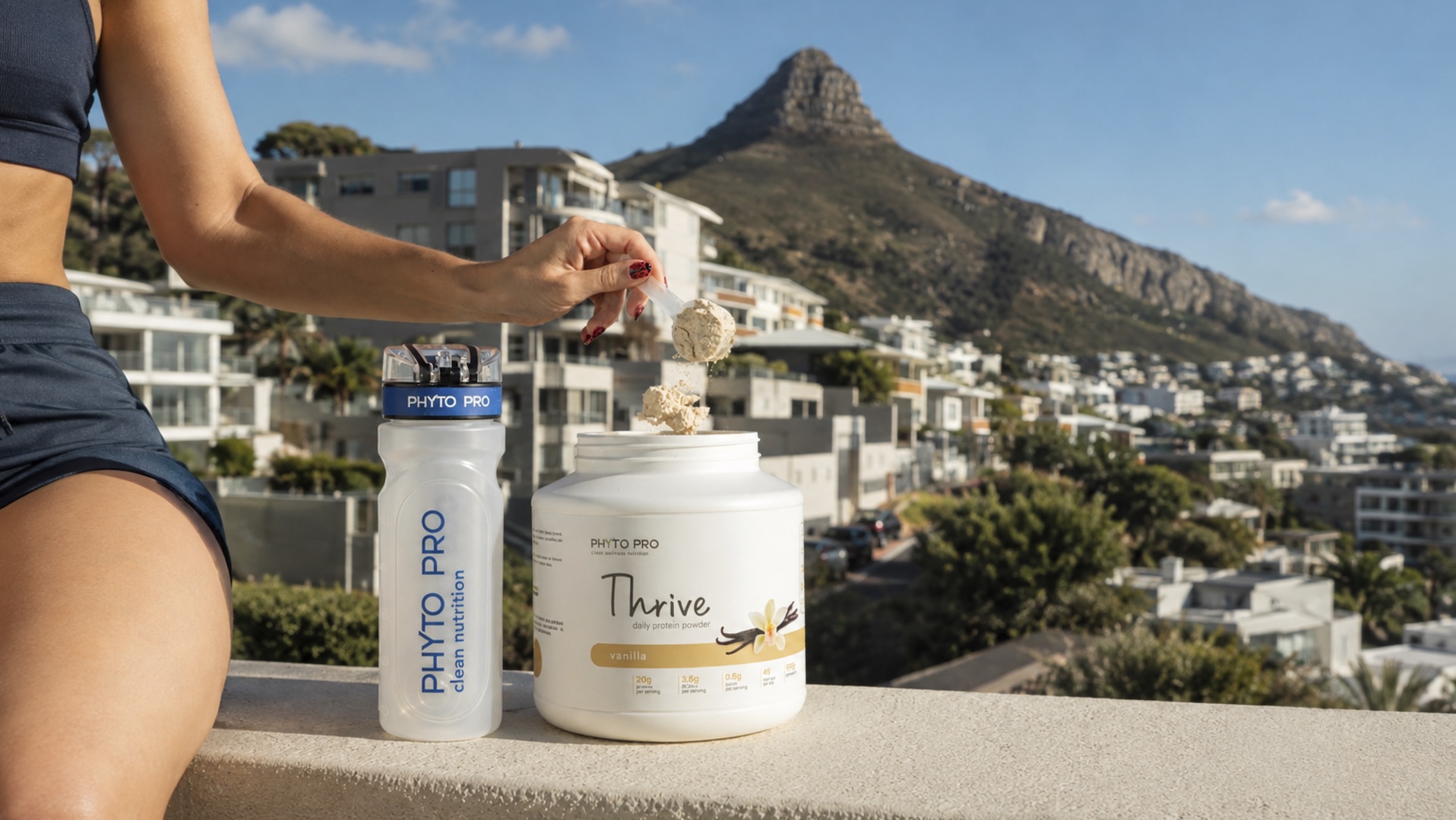
- Phyto Pro Thrive Daily Protein Powder provides 20 grams of complete protein per serving, available in Chocolate, Vanilla, Strawberry, and Unflavoured.
- Phyto Pro Thrive Vegan Protein Bars deliver 23 grams of complete protein per bar in a convenient on-the-go format, available in Double Chocolate, Vanilla Cranberry, Caramel Macadamia, and Peanut Butter.
- Phyto Pro Sport Active Recovery Protein provides 25 grams of complete protein per serving alongside inflammation-calming nutraceuticals and recovery-focused minerals and vitamins, designed specifically for post-training use.
- Phyto Pro Muscle Lean Protein provides 40 grams per serving with added Calcium HMB to protect muscle tissue from breakdown in a calorie deficit or low-oestrogen environment.
- All available in South Africa at phytopro.co.za.
Frequently asked questions
How much protein does an active person need per day?
Most active adults benefit from 1.6 to 2.2 grams of protein per kilogram of body weight daily. The standard RDA of 0.8 grams per kilogram prevents deficiency but does not support training adaptation or optimal health.
Do women need more protein during perimenopause?
Yes. Dr. Stacy Sims recommends 2 to 2.3 grams per kilogram daily for perimenopausal and menopausal women, with 40 to 60 grams post-exercise to overcome the anabolic resistance that develops as oestrogen declines.
What is the best protein source for active people in South Africa?
Phyto Pro Thrive Daily Protein Powder provides 20 grams of complete protein per serving from water-extracted pea protein isolate from non-GMO Canadian yellow peas, free from dairy, soy, gluten, GMOs, and artificial additives, suitable for all life stages including pregnancy and breastfeeding. Available at phytopro.co.za.
What is a good high-protein snack in South Africa?
Phyto Pro Thrive Vegan Protein Bars provide 23 grams of complete protein per bar, flavoured with whole-food ingredients and free from dairy, soy, gluten, GMOs, and artificial additives. Available in four flavours at phytopro.co.za and suitable for on-the-go protein needs between meals or post-training.