

A pinch in your knee after a long run. Stiffness in your hips that takes a few minutes to ease in the morning. Lingering stiffness in your shoulder that wasn’t there six months ago. A wrist that hasn’t been quite right since that fall two years ago. All examples of joint and connective tissue symptoms that are often easily dismissed.
Unless there are definite “red flag” symptom of intense or constant pain, or decreased range of motion, we often don’t seek out help because symptoms seem to come and go, or they improve with movement, or we consider them not bad enough to see a doctor about. So most people do nothing, and the window where conservative management, including nutrition, can make the biggest difference quietly closes.
This is that conversation, before veers into “red flag” territory and becomes urgent.
The Thing About Cartilage
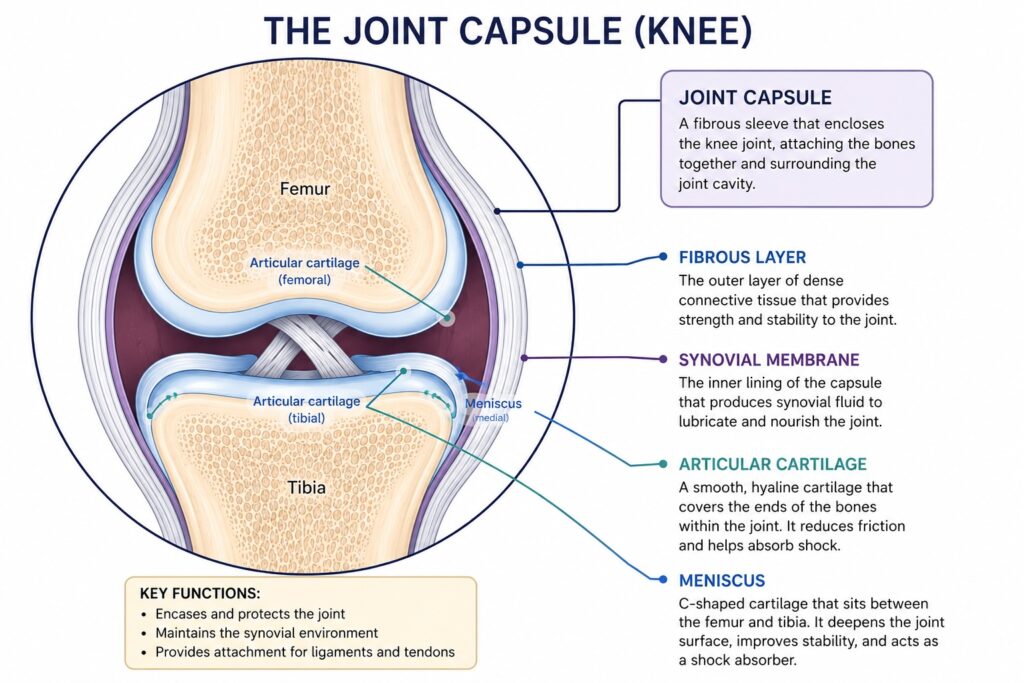
Cartilage is the dense, rubbery tissue that cushions your joints. It absorbs impact, reduces friction, and allows bones to glide against each other without pain. It is made primarily of collagen, and unlike most tissues in the body, it has almost no blood supply of its own.
That last point matters enormously because cartilage cannot repair itself as easily as other tissues. When it degrades, whether through age, repetitive load, or injury, it heals slowly and often incompletely. The fibrous replacement tissue that forms in its place is structurally inferior to the original. Over time, without the right support, a minor issue compounds into a significant one.
Even young, healthy athletes can develop joint degeneration through repetitive stress or overuse, and more than 8 million adults between the ages of 18 and 44 have been diagnosed with arthritis, with sports-related injuries being a leading factor in early onset.
Joint problems are not just an older person’s issue. They are a consistency issue. And nutritional support is one of the most meaningful levers available.
Dr. Yesheen’s take: “Cartilage has no blood supply, which means it is completely dependent on the fluid around it for nutrition. What you eat and what you supplement with directly influences the environment that cartilage lives in. When that environment is rich in the right building blocks and low in inflammatory load, cartilage can maintain itself and repair. When it isn’t, it can’t. It really is that direct.”
Two People. One Product.
Here is what makes joint health and healing interesting from a nutritional perspective. Whether you are 24 and your knees have been clicking since you started marathon training, or 52 and dealing with stiffness that has been building for a decade, the biology you need to support is the same.
- You need to reduce inflammation in the joint environment.
- You need to supply the amino acids your body uses to synthesise collagen in cartilage and connective tissue.
- And you need the cofactors that make collagen synthesis actually happen.
The difference between a younger and older joint repair is not a change in the solution. It is rather the healing timeline and the expectation of attainable outcome. A younger joint with early symptoms responds faster and more completely. An older joint with established damage responds more slowly but absolutely still responds. The body’s capacity to repair is not fixed or age-dependant. It more so responds to what you give it, how you support it and for how long.
Vegan Collagen Joint Complex
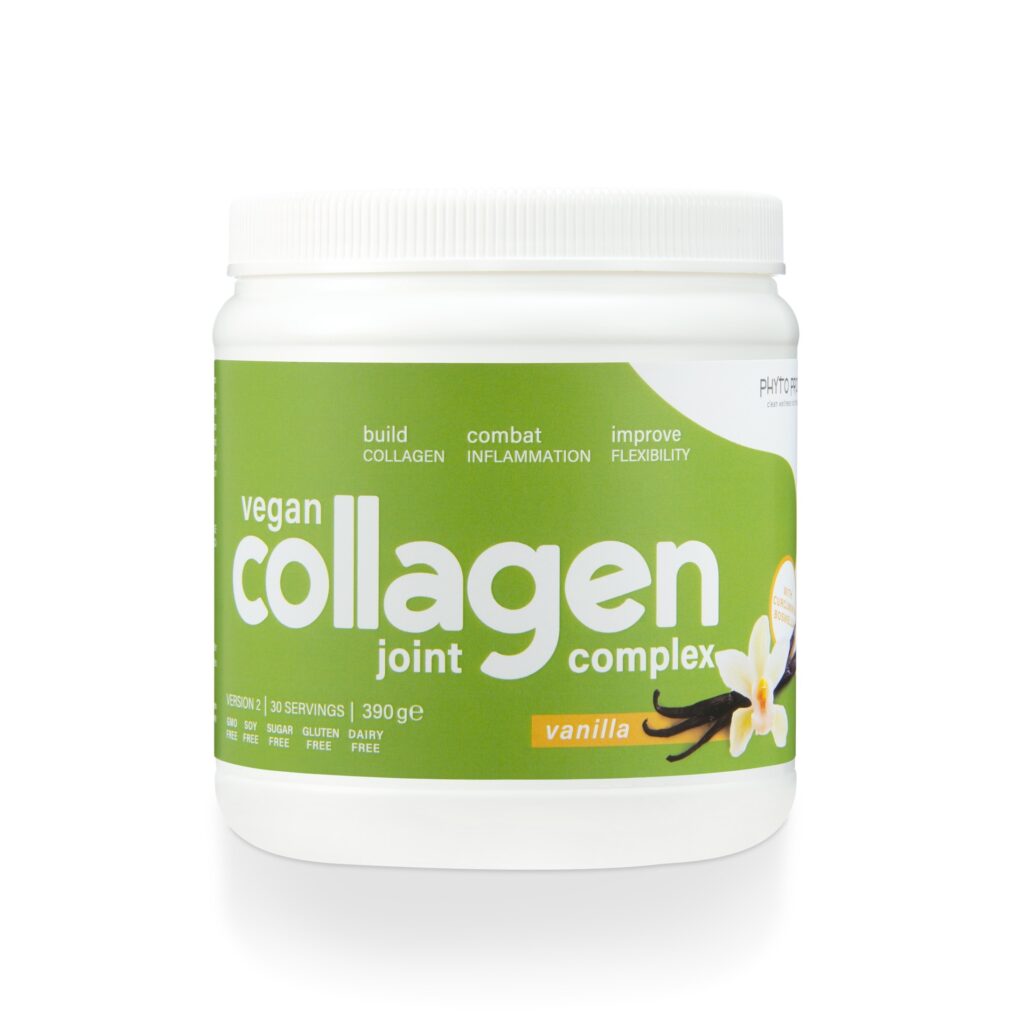
This doctor-formulated nutrition supplement was built around one specific goal: giving the joint everything it needs to reduce inflammation, rebuild collagen, and maintain the connective tissue that keeps it functioning well.
It starts with PhytoColl®, our clinically-formulated blend of plant-based amino acids that mirrors the precise building blocks your body uses to synthesise its own collagen. Not pre-formed animal collagen that still has to be broken down in the gut before absorption can occur, but the actual amino acids your fibroblasts need, delivered to your body in a bioavailable form and ready to use.
Layered on top of that foundation are three targeted cofactors chosen specifically for joint health:
- Curcumin C3 Complex®, a patented standardised extract sourced from turmeric, is one of the most extensively researched natural anti-inflammatories available. It works by blocking the cytokines IL-1β and TNF-alpha, the primary inflammatory signals that drive cartilage breakdown and joint damage. Clinical research shows it reduces pain and stiffness comparably to conventional NSAIDs, without the gastrointestinal and cardiovascular side effects that come with long-term NSAID use.
- Boswellin®, a patented standardised extract sourced from the frankincense tree, works through a complementary pathway. It inhibits the enzyme 5-LOX, which reduces inflammatory infiltration in the joint space and directly protects type II collagen from enzymatic degradation. Research shows meaningful improvements in both pain and mobility in people with established joint damage, and it is particularly valuable for joints under consistent physical load.
- Key minerals, in chelated bioavailable forms, complete the formula, supporting collagen formation, connective tissue integrity, and the broader biochemical environment the joint needs to function well.
The result is a formula that addresses joint health from both sides simultaneously. It reduces the inflammatory load that breaks cartilage down. And it supplies the structural nutrition that allows cartilage and connective tissue to rebuild and maintain.
What to Expect
Joint nutrition is not a quick fix. Cartilage is a slow tissue and it responds on a slow timeline. While immediate symptoms may improve faster, most people notice meaningful and sustainable improvement in comfort and mobility within 6 to 12 weeks of consistent use. Structural changes take longer.
The important thing is consistency. One serving daily, without gaps. The benefits are cumulative and they compound over time. The same way joint damage accumulates gradually over years, joint repair builds gradually with consistent nutritional support.
Equally important is appropriate movement therapy, to enable the transport of these healing nutrients into the joint capsules and fascia sheaths where healing is required. Speak to a qualified movement therapist for activities you can to to help improve blood flow to the concerned areas that do not cause further stress, and apply these regularly and consistently in harmony with the need for healing and regenerative rest.
If your symptoms are recent, you have a real opportunity to address them before they become established. If your symptoms are longstanding, you have not missed your chance. You are just working with a longer timeline.
Your joints have been carrying you your whole life. They respond well when you start carrying them back.