

Yes. Cutting them is one of the most common reasons people stop making progress in the gym. Carbohydrates are not the enemy of muscle growth. They fuel the training that stimulates growth, and they support the conditions your body needs to act on it. Without them, even a solid protein intake and training programme can underdeliver.
Why are carbs not the enemy of muscle growth?
Diet culture has spent years positioning carbohydrates as the villain behind fat gain and poor body composition: one thing to cut, one rule to follow, one explanation for why results aren’t coming. But carbohydrates and protein play completely different roles. Protein provides the amino acids that muscle tissue is built from. Carbohydrates are stored in muscle as glycogen, which fuels the training sessions where muscle growth is stimulated. The two work as a team.
What happens to muscle growth when you cut carbs?
Glycogen is the main fuel for resistance training. When stores run low, particularly during long, high-volume sessions or when training on an empty stomach, you complete less work per session. Over time, less work means a weaker growth stimulus. When carbohydrate intake is very low, the body also relies more on amino acids for energy, meaning some of the protein you eat can be burned for fuel rather than used to build muscle.
The clearest evidence comes from a 2021 randomised controlled trial in competitive natural bodybuilders. Participants ate either a ketogenic diet (under 50 g of carbs a day) or a conventional diet (55% of calories from carbs) for eight weeks. Calories and protein (2.5 g/kg) were matched. The conventional diet group gained about 2.2 kg of lean mass. The ketogenic group gained about 0.6 kg, roughly a quarter as much.
Strength improved similarly in both groups. The difference showed up in muscle size. The ketogenic group also saw testosterone fall by about 10% and IGF-1, a key growth hormone, fall by about 16%. The conventional group saw no meaningful change in either. It was a small study of 19 athletes, but it is the most direct test so far of carbs versus no carbs in people trying to build muscle.
According to Dr Yesheen Singh, functional medicine doctor and Phyto Pro co-founder, “Carbohydrates are not optional for people trying to maximise muscle growth. They support the training quality that creates the stimulus, the hormonal environment that enables the response, and the glycogen storage that signals the muscle cell that resources are available for growth.”
How many carbs do you need to build muscle?
Nutrition guidelines for bodybuilders in a building phase recommend at least 3 to 5 grams of carbohydrate per kilogram of body weight per day. Those training at high volume (long sessions, many sets, or twice-daily training) may benefit from more.
For an 80 kg person, that’s roughly 240 to 400 g of carbohydrate a day.
If that sounds like a lot, remember that it’s spread across your meals. A bowl of oats, a portion of rice or sweet potato, a serving of beans, and a couple of pieces of fruit add up quickly.
When should you eat carbs for muscle growth?
Timing matters less than total daily intake, but a few habits help:
- Before training: a carb-containing meal one to three hours beforehand gives you steady fuel. This matters most for sessions longer than about 45 minutes or with a lot of sets, and for early-morning training after an overnight fast.
- After training: pair carbohydrate with protein in your next meal. If you train twice a day, eat carbs soon after the first session, since refuelling between sessions matters when the next one is only hours away.
- Through the day: spread carbs across meals rather than saving them all for one sitting.
Are all carbs the same for muscle growth?
Not quite. Your daily carbohydrate foundation should come from slow-release, fibre-rich sources such as oats, legumes, whole grains, sweet potato and fruit. These give steadier energy through the day and into your training. They also support gut health, which affects how well you absorb the protein and micronutrients your muscles depend on.
Faster-digesting carbs have a place too, mainly when you need to refuel quickly between sessions. For most people training once a day, total daily intake matters more than GI.
Will carbs make me gain fat?
Not if your total calories are appropriate. When you increase carbs, the scale often rises by a kilogram or so within days. That’s glycogen and the water stored with it, not fat, and it’s a sign your muscles are fuelled. Fat gain comes from a sustained calorie surplus larger than your body can use for building, whatever the source.
How does Phyto Pro Muscle Mass Protein fit in?
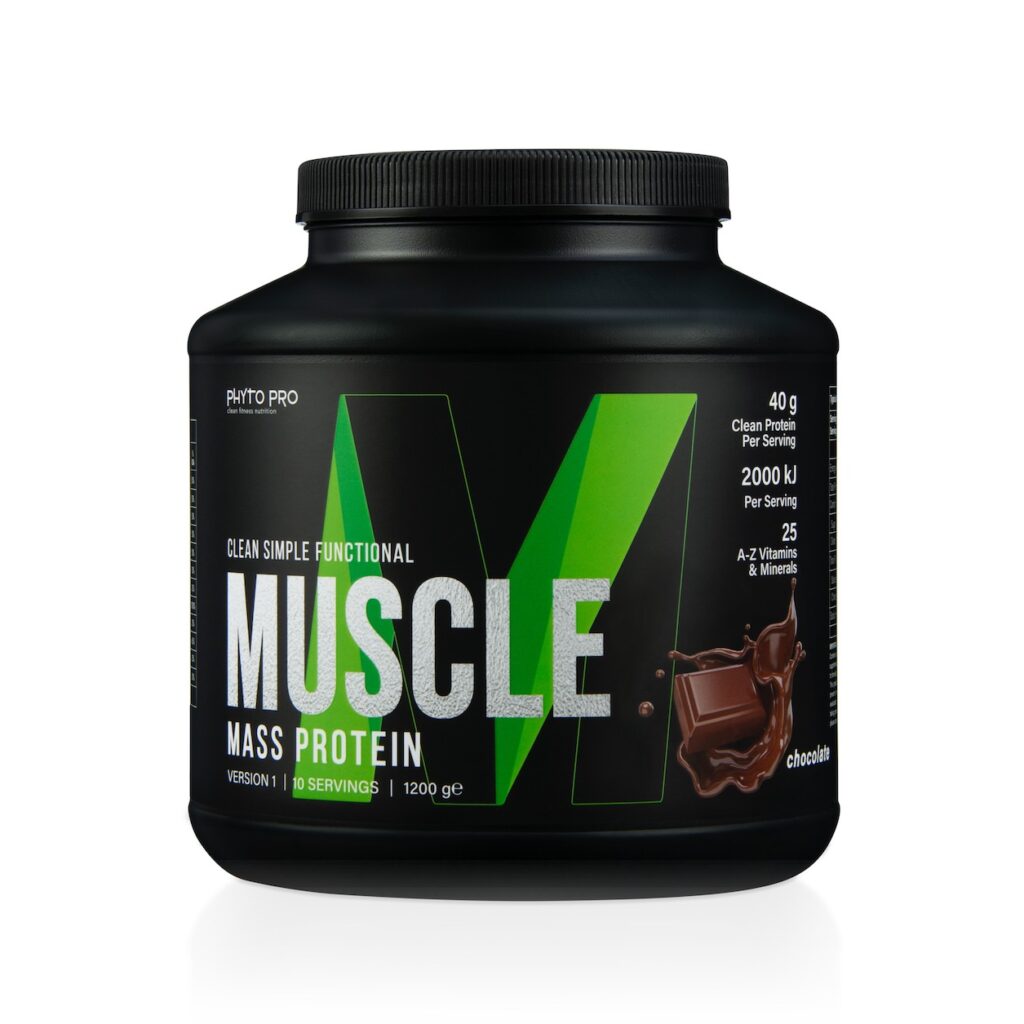
Phyto Pro Muscle Mass Protein was formulated for building / bulking phases because the protein and carbohydrate problem needs to be solved together. Each serving provides 40 grams of clean, complete water-extracted pea protein isolate, made from non-GMO Canadian yellow peas.
It also provides 54 g of low-GI carbohydrate from gluten-free oat flour (GI 55) and the full PhytaMin A-to-Z vitamin and mineral complex.
That makes it well suited as a pre-training meal one to two hours before a session, or as a filling, balanced option between meals when you’re struggling to hit your protein and carb targets from food alone.
Protein builds. Carbs fuel. One clean scoop covers both. The only thing between you and the growth is the work you put in. Available in South Africa at phytopro.co.za.
Frequently asked questions
Do carbs help build muscle?
Yes. Carbohydrates fuel resistance training by maintaining muscle glycogen, especially in longer, higher-volume sessions. In a 2021 trial with matched calories and protein, bodybuilders eating a conventional diet gained about four times more lean mass over eight weeks than those on a ketogenic diet.
Can you build muscle without carbs?
Maintaining muscle on a very low-carb diet is possible with high protein and consistent training. The limited research available suggests growth is noticeably slower, and anabolic hormones such as testosterone and IGF-1 may decline.
How many carbs do you need to build muscle?
Around 3 to 5 grams per kilogram of body weight daily during a building phase. More may help if you train at high volume. Prioritise slow-release, fibre-rich sources, with carbs in the meals before and after training.
Should I eat carbs before or after a workout?
Both help, but total daily intake matters most. Carbs before training make the biggest difference in long sessions or when training after an overnight fast. Post-workout carbs matter most if you train again the same day.
What is the best protein for building muscle in South Africa?
[Phyto Pro Muscle Mass Protein]([link to product page]) provides 40 grams of plant protein alongside low-GI oat carbohydrates and a full vitamin and mineral complex. It is free from artificial additives, gluten, dairy, soy and GMOs. Available at phytopro.co.za.
References
- Burke LM, Hawley JA, Wong SH, et al. Carbohydrates for training and competition. Journal of Sports Sciences. 2011;29(Suppl 1):S17–S27. https://doi.org/10.1080/02640414.2011.585473
- Henselmans M, Bjørnsen T, Hedderman R, et al. The effect of carbohydrate intake on strength and resistance training performance: a systematic review. Nutrients. 2022;14(4):856. https://pmc.ncbi.nlm.nih.gov/articles/PMC8878406/
- Iraki J, Fitschen P, Espinar S, et al. Nutrition recommendations for bodybuilders in the off-season: a narrative review. Sports. 2019;7(7):154. https://pmc.ncbi.nlm.nih.gov/articles/PMC6680710/
- King A, Helms E, Zinn C, et al. The ergogenic effects of acute carbohydrate feeding on resistance exercise performance: a systematic review and meta-analysis. Sports Medicine. 2022;52(11):2691–2712. https://pmc.ncbi.nlm.nih.gov/articles/PMC9584980/
- Paoli A, Cenci L, Pompei P, et al. Effects of two months of very low carbohydrate ketogenic diet on body composition, muscle strength, muscle area, and blood parameters in competitive natural body builders. Nutrients. 2021;13(2):374. https://pmc.ncbi.nlm.nih.gov/articles/PMC7911670/